
Dimensionally stable and feather-light: Zerodur lightweight structures for the aerospace industry
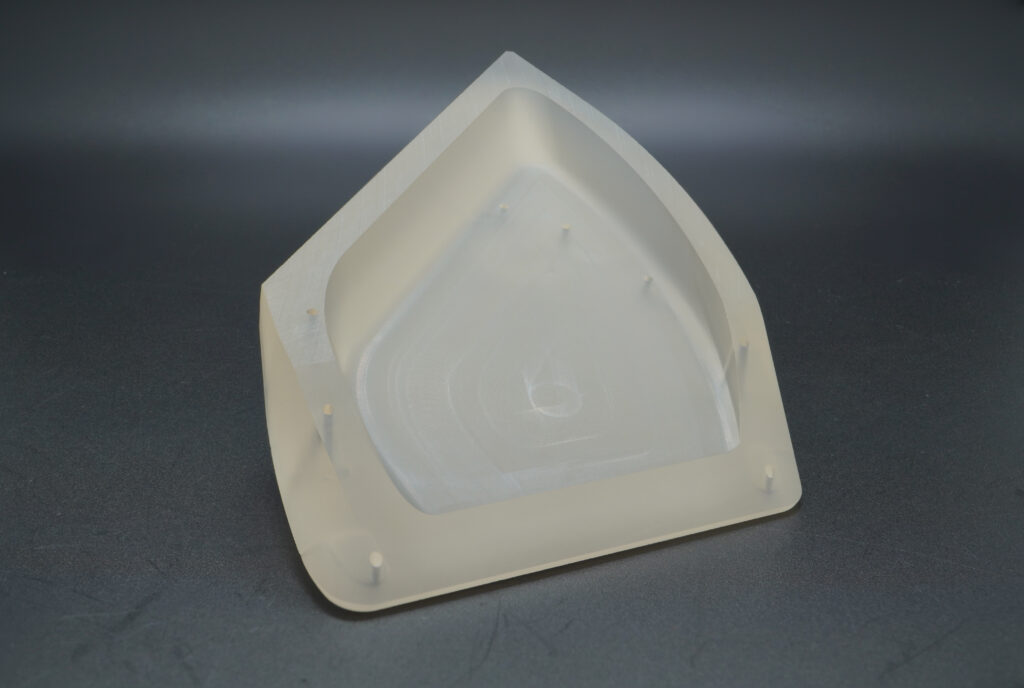
ShapeFab machines Zerodur® for the aerospace sector. Using high-precision 5-axis CNC coordinate grinding, we produce lightweight structures and complex free-form surfaces with visually striking finishes – achieved through a combination of grinding, lapping and pre-polishing on a single machine. The Zerodur base components we manufacture are used, amongst other things, in the laser retroreflector for the GRACE gravity field mission.
REFERENCE · SPACE TRAVEL
Zerodur base components for the GRACE mission’s laser retroreflector
What this is all about.
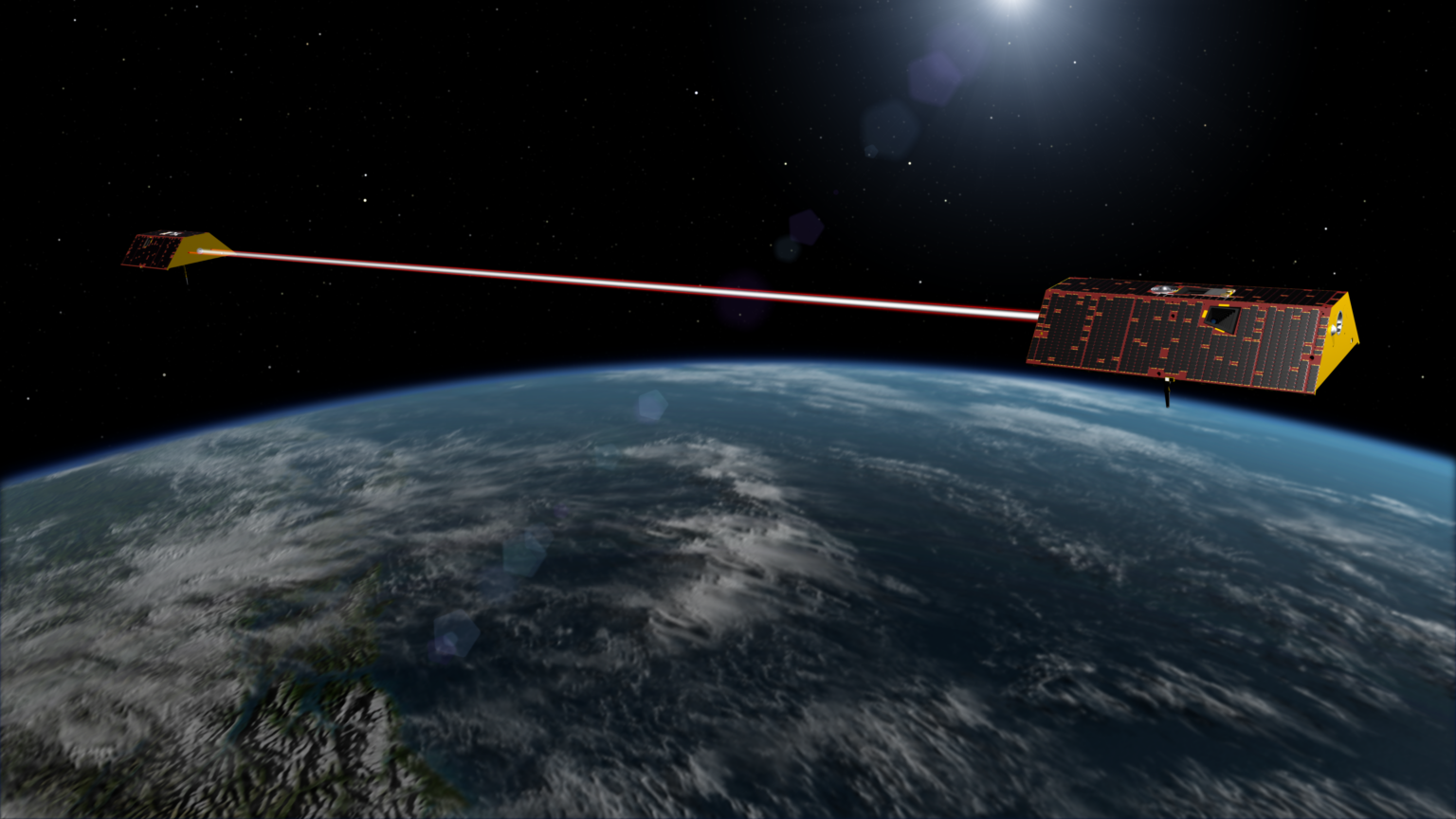
The GRACE gravity mission measures the Earth’s gravitational field using a pair of satellites flying one behind the other in the same orbit, at a distance of around 200 km apart. Tiny changes in this distance, measured in the nanometre range, can be used to deduce shifts in mass – such as changes in groundwater levels, droughts or melting ice masses. This data is incorporated, amongst other things, into the well-known geoid model developed by the GFZ Potsdam, the ‘Potsdam Gravity Potato’, and forms a key basis for monitoring the global water cycle and climate change.
The technical challenge.
A laser ranging interferometer measures the distance between the two satellites to within fractions of a light wavelength. At the heart of the system is a triple-mirror retroreflector (Triple Mirror Assembly), which deflects the laser beam between the satellites – its virtual apex lies exactly at the satellites’ centre of gravity. The mirror assemblies are made of Zerodur and are responsible for precision alignment. Any thermal or mechanical instability would distort the measurement.
Our contribution.
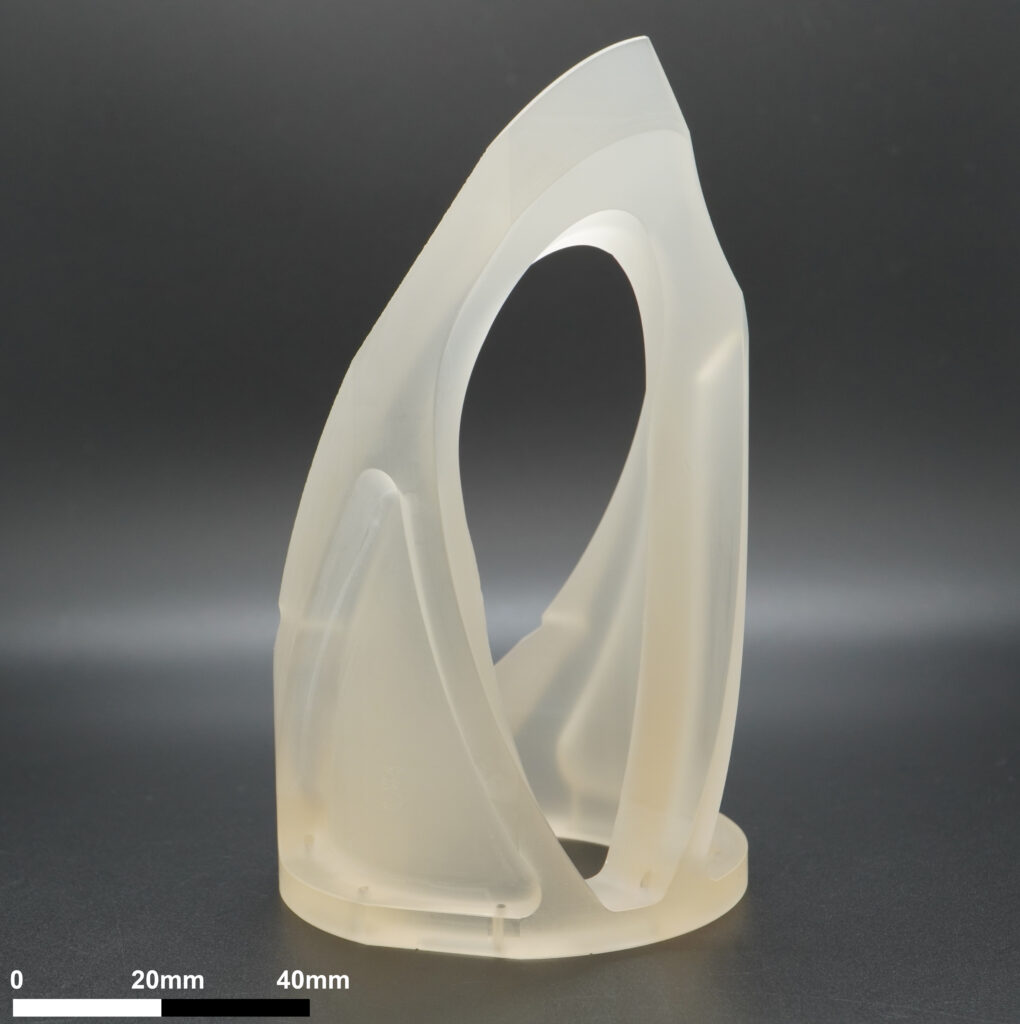
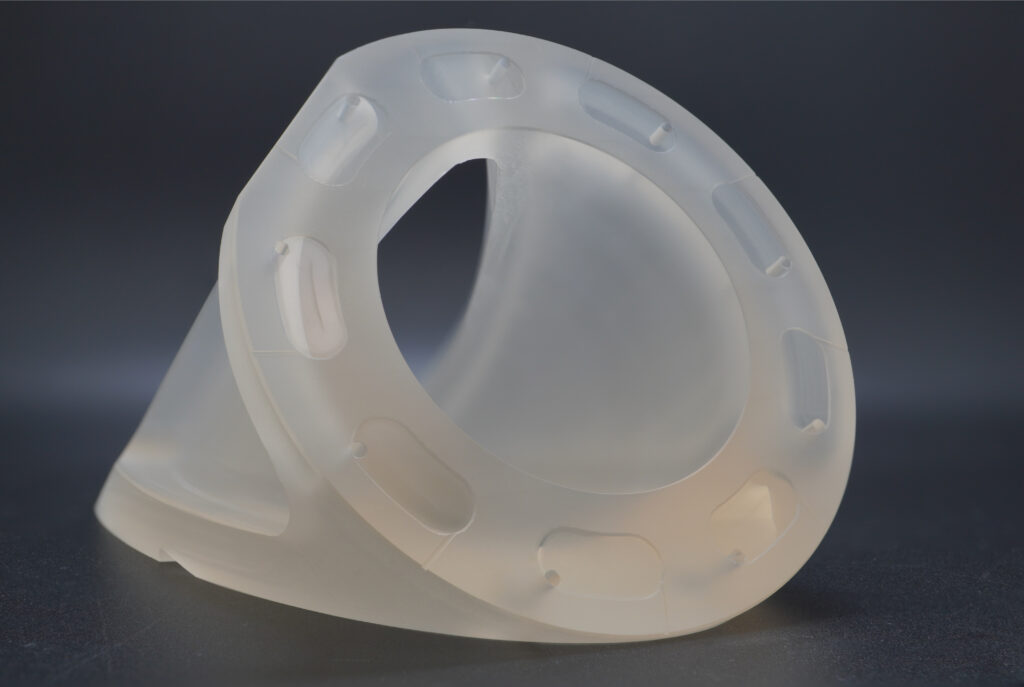
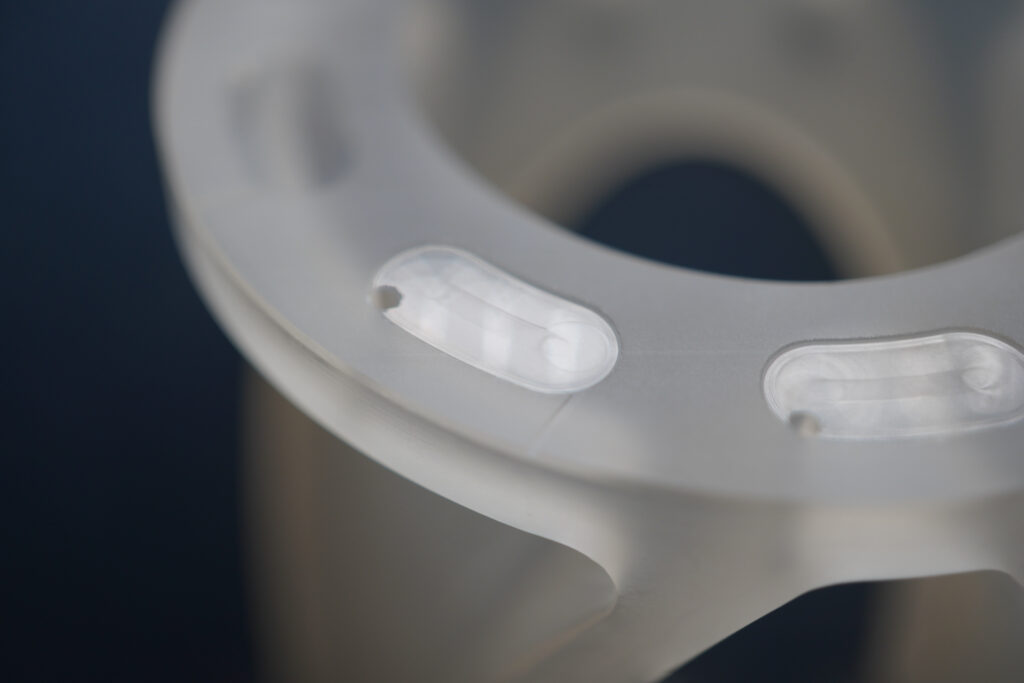
To ensure that the interferometer can measure with an accuracy of just a few nanometres, the optical components must be absolutely dimensionally stable and dimensionally accurate – yet as light as possible for the launch. ShapeFab manufactured the Zerodur base components of the retroreflector using 5-axis CNC machining, thereby combining three requirements that would otherwise be mutually exclusive in a brittle material:
- complex 5-axis free-form geometries with integrated lightweight structures
- Tolerances of 20 µm for large, precision functional surfaces
- Surface finishes of Ra < 0.1 µm – achieved directly through CNC machining, without any subsequent specialised processes
As part of a network.
The project was carried out in collaboration with Carl Zeiss AG, Hensoldt Optronics GmbH, SpaceTech GmbH and the Deutschen Zentrum für Luft- und Raumfahrt e. V. (DLR). ShapeFab manufactured the precision-machined Zerodur base components for the mirror system.



Zerodur® material properties (approximate values)
Properties | Value |
|---|---|
Density | 2,53 g/cm³ |
Wärmeausdehnungskoeffizient (CTE, 0–50 °C) | 0 ± 0,007 bis 0 ± 0,100 10⁻⁶/K (je nach Ausdehnungsklasse) |
Modulus of elasticity (20 °C) | 90,3 GPa |
Poisson's ratio | 0,24 |
Knoop-Härte (HK 0,1/20, ISO 9385) | 620 |
Wärmeleitfähigkeit (20 °C) | 1,46 W/(m·K) |
Max. Anwendungstemperatur | 600 °C |
The virtually negligible coefficient of thermal expansion is the defining characteristic of Zerodur® – it is an order of magnitude lower than that of most glass materials. (Source: SCHOTT AG)
Why have Zerodur® CNC-machined?
Zerodur® is hard and brittle. It can be ground with precision and polished to a high optical finish, but is sensitive to machining errors – particularly on the thin webs and pocket walls of lightweight structures. Incorrectly designed clamping, unsuitable tools or excessive cutting forces lead to edge chipping or invisible subsurface damage, which impairs the optical performance.
Our advantage lies in the integrated process chain: grinding, lapping and polishing are carried out in a single set-up on 5-axis CNC machining centres. This reduces the risk associated with re-clamping and handling, particularly for the thin-walled, fracture-prone geometries that characterise lightweight structures – and ensures that tolerances and surface finishes remain consistent throughout the entire machining process. Each component is then inspected using multi-sensor coordinate measuring technology.
Lightweight structures made from Zerodur®
Lightweight structures made from brittle, hard material: maximum weight reduction whilst maintaining stiffness and the functional surface area. By using pocket and rib structures, we reduce the component’s weight whilst retaining the mechanical stability required for it to withstand the launch loads of a rocket.
- 5-axis simultaneous machining of complex 3D geometries and free-form surfaces
- integrated lightweight structures (pockets, ribs)
Example production parameters
Production characteristic | Value |
|---|---|
General manufacturing tolerances | up to ± 3 µm |
Toleranz auf 3D-Freiformflächen | 20 µm über große Flächenbereiche |
Oberflächenrauheit (Ra) | bis < 0,1 µm aus der CNC-Bearbeitung; <20 nm im Polierprozess |
Maximale Bauteilgröße | 400×500×200 mm |
Certification | ISO 9001 |
Batch size | ab 1 Stück |
Possible components & applications
- Retroreflectors and mirror holders for laser interferometry
- Mirror substrates and lightweight mirrors for optical systems
- Optical benches and structural components
- Components for metrology and precision positioning
- Vacuum clamping plates made from Zerodur
Typical sectors
- Space travel
- Optics & Photonics
- Semiconductors/Lithography
FAQ
Why is Zerodur® used in the space industry?
Due to its virtually negligible thermal expansion, optical systems made from Zerodur® remain dimensionally stable even in the face of temperature fluctuations. When combined with lightweight structures, this results in components that meet both the optical precision and weight requirements of a space mission.
Does ShapeFab manufacture Zerodur®?
No. Zerodur® is a material produced by SCHOTT AG. ShapeFab is a development and manufacturing service provider that uses 5-axis CNC machining to process the material into finished precision components – including lightweight structures, free-form surfaces and the pre-finishing of optical surfaces.
Do you manufacture Zerodur components in quantities as small as one?
Yes. We manufacture from a batch size of 1 – from prototypes and one-off items through to small production runs.
What surface finishes and tolerances are possible with Zerodur®?
We achieve surface finishes of up to Ra < 0.1 µm through CNC machining, as well as <20 nm Ra through pre-polishing, and tolerances of up to ± 3 µm; on complex 3D free-form surfaces, 20 µm over large surface areas. The values achievable in individual cases depend on the geometry and the requirements.
Why ShapeFab?
- Over 27 years of experience in the precision machining of hard, brittle materials
- Innovative combination of grinding, lapping, and polishing technologies on a single CNC machine (details)
- ISO certified, development and manufacturing in Germany
- Personal consultation by our technical experts
- Short quotation and delivery times, express deliveries available on request